|
Home
| AT
Overview
| Typical Lesson
|
Teacher Qualifications
|
Recommended Reading
| In the newsTo learn more
| Jill
Geiger, certified teacher
| Testimonials
|
|||
| |
|||
| comments from some of my pupils | |||
| .. |
|
||
|
Chris M. (56) |
"The Alexander Technique improved my dancing skills almost immediately. After only a few lessons, my dance teachers remarked that my following abilities had dramatically improved, as if a switch had been flipped." Holly B. (40) |
||
"After years of frequent
debilitating headaches I haven’t had one since about 2
- 3 months after starting lessons with Jill many years
ago." Debbie G. (54) |
|
"I feel that the process is profound.
There’s a mind-body connection that’s very clear. Every now and
then you come across something that opens a window and
as I’m experiencing this, it is opening a window."
|
|
"Normally when I go to conventions
I do a lot of walking and my back gets very sore
within a day or so. This time I just kept going the
whole time and didn’t develop any sore back or sore
legs. I
was with a friend who kept complaining that his feet
were hurting and I was just feeling younger."
|
I am delighted by the unexpected
outcomes of this work -- like less effort when I sing
and more comfort in daily acts of living. My
revelation is that I can unlearn the habitual
muscle contractions that create pain. And not be
on a perpetual treadmill of treating symptoms rather
than root cause." |
"I used to get extreme arm pain when
working at the computer or while playing the piano.
After a few months of working with Jill I became
aware of a constant tension I was holding in my body
and soon my entire physical being shifted.
|
|
|
|
|
||
|
Susan M. (54) |
Bob R. (63)
|
||
"I've noticed something interesting since taking lessons that I wasn't expecting. I was walking my dogs in the snow and while they were stopped to smell whatever it is that they are fascinated by, I glanced back the way we came and saw my tracks in the snow. It used to be that I walked somewhat splay-footed but I was surprised to see that my steps were largely parallel to each other." Dennis W. (46) |
"My neck and shoulders were so
injured that I really felt like this would be me for
the rest of my life, that I would never be able to
relax them. Even
when I tried to relax them I couldn’t. And now it’s
like nothing. Now
I’m worried about other stuff, not the relaxing of my
neck and shoulders." Janet R. (63) |
"One of the things I've learned is noticing tension in almost anything that I do. Whether I'm doing yoga or weight lifting, I find that you don't have to have your whole body being tight and tense and if you can release and not have that tension everything becomes so much easier."
|
|
"Before coming here I had
very severe shoulder pain that disrupted my
sleep. Little by little over the past 3 - 4
weeks it has subsided so that it no longer wakes me
up at night and I can raise my hand over my head
without pain."
Susanne I. (48)
Victor D. (74) |
Lenore talks about the changes she experienced 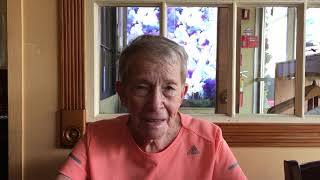 |
"It’s good to know that no matter
what the circumstances I have the choice to be able to
free tension in order to be more effective or just to
improve how I’m doing things. It’s always
a virtue to be freeing."
|
|
| .. |
|||
|
quotes
from notable pupils of the AT
|
|||
| .. | .. |
||
"Mr. Alexander has done a service to the subject [of the study of reflex and voluntary movement] by insistently treating each act as involving the whole integrated individual, the whole psychophysical man. To take a step is an affair, not of this or that limb solely, but of the total neuromuscular activity of the moment, not least of the head and neck." Sir Charles Sherrington (1857-1952) Neurophysiologist Nobel Prize for Medicine 1932 |
"We already notice, with growing amazement, very striking improvements in such diverse things as high blood pressure, breathing, depth of sleep, overall cheerfulness and mental alertness, resilience against outside pressures, and in such a refined skill as playing a musical instrument." Nikolaas Tinbergen (1907-1988) Nobel Prize for Physiology/Medicine 1973 (from his Nobel Prize acceptance speech, half of which was dedicated to the AT and changes that he and his family experienced from lessons) |
"Mr. Alexander's method lays hold of the individual as a whole, as a self-vitalising agent. He reconditions and reeducates the reflex mechanisms and brings their habits into normal relation with the functions of organisms as a whole. I regard his method as thoroughly scientific and educationally sound." George E. Coghill (1872-1941) Biologist, Anatomist member of National Academy of Sciences |
|
|
"Through
the
Alexander Technique I was able to rehabilitate my
running after 25 years of being unable to run
through injuries, to the extent that I was able to
set ten world records for veterans in 1982." |
"Forty years ago, after one of my concerts, Adrian Boult told me that if I continued to conduct like that I'd become a cripple, and that I must take lessons in the Alexander Technique. Today I am still having lessons - as with music, there is no end to the learning process. It affects not only the use of the body, but also one's views of oneself and one's behavior. For the aches and ills that come with the years, the Technique can work miracles." Sir Colin Davis |
||
"My times became faster as I looked at the readouts on my displays while training using the AT. It was a real boost to my mental training to have the AT in my back pocket when I placed ninth in the 1999 Canadian women's Open Lightweight Erging Championships and when I rowed in the Masters Nationals (5 gold) and World Lightweight Championships (2 gold) and the Royal Canadian Henley Regatta (1 gold). I was thrilled with my placings in these events and I can definitely say without hesitation that I wouldn't have had the rowing success that I have had the luxury of experiencing in my short time on the water without finding the AT and the great teachers that I have had the privilege to work with." Valerie Thompson Williams Rowing masters gold medalist |
"I find the Alexander Technique very helpful in my work. Things happen without you trying. They get you to be light and relaxed. You must get an Alexander teacher to show it to you." John Cleese Actor, Comedian Ministry of Silly Walks |
||
“Using the Alexander Technique empowers me and gives me a balanced sense of tension rather than relying on creating tension to do something in order to produce a sound or an act that is preconceived. I realized that I cannot control a set of circumstances outside of myself so I can go on a journey relying on the state of mind and body that the Alexander Technique gives me.” Alan Rickman Actor |
"I was born with no natural aptitude. I wasn't pretty. I moved with no grace at all. I auditioned for the London Academy of Musical and Dramatic Arts but was not accepted. When I was finally admitted to Central School of Speech and Drama and showed up at my first movement class with my hump back and wearing a leotard, the movement teacher said, "Oh God." He sent me to the head of the school who then sent me to study the Alexander Technique with Dr. Wilfred Barlow. That whole semester I took Alexander lessons instead of attending movement classes which helped me enormously in my training and in subsequent years in my acting work. Now I can play people who are graceful and beautiful." Lynn Redgrave Actor |
||
| "Lesson "Lessons in the Alexander Technique taught me how to sit in a state of lumbrosacral poise, and my chronic low back pain gradually became cured. The Technique is true education. Compared to surgery (e.g. for low back pain or for chronic obstructive lung disease) a course of instruction is inexpensive." John H. M. Austin, MD Professor of Radiology; Chief, Division of Radiology Columbia-Presbyterian Medical Center, New York, NY |
"The Alexander Technique can help relieve pain and prevent recurrences by correcting poor posture and teaching proper patterns of movement." Andrew Weil, MD |
||
|
"Alexander
established not only the beginnings of a far reaching
science of the apparently involuntary movements that
we call reflexes, but a technique of correction and
self control which forms a substantial addition to our
very slender resources in personal education."
|
"The Alexander Technique keeps the body alive, at ages when many people have resigned themselves to irreversible decline." Robertson Davies Writer |
"Personally, I cannot speak with too much admiration--in the original sense of wonder as well as the sense of respect--of the persistence and thoroughness with which these extremely difficult observations and experiments were carried out. In consequence, Mr. Alexander created what may be truly called a physiology of the living organism. His observations and experiments have to do with the actual functioning of the body, with the organism in operation, and in operation under the ordinary conditions of living--rising, sitting, walking, standing, using arms, hands, voice, tools, instruments of all kinds." John Dewey Educator and Philosopher |
|
"The Alexander Technique can be sustaining; it is something that if learned well, can be carried along with you for the rest of your life. It gives you confidence to be who you are when you are up in front of an audience." Patrick Maddams Managing Director, Royal Academy of Music |
"Good acting is revealing yourself, not covering yourself up. If your body is free, your mind is free. [The Alexander Technique allows] you to feel what it's like to stay open physically, and also stay fully involved in whatever you're supposed to be doing." Annette Bening Actor |
||
| "[The Alexander Technique] is a way to transform stress to joy. It's my way of keeping on track with work
and truth and the world I’m in which is working with
people and creating. It’s for anyone who
wants to be in contact with their own body and the way
we tense ourselves and relax ourselves. It’s another
way of moving."
|
|
||
"I started in radio at age 23. When I get nervous my voice tends to get higher and faster and I sounded like Minnie Mouse. The thing that really helped me is that I took Alexander Technique lessons for many years." Terry Gross Host of Fresh Air, NPR radio program |
"The Alexander Technique works... I recommend it enthusiastically to anyone who has neck pains or back pain." Roald Dahl Writer |
"Instead of feeling one's body to be an aggregation of ill-fitting parts full of friction and dead weights pulling this way and that, so as to render mere existence in itself exhausting, the body becomes a coordinated and living whole, composed of well-fitting and truly articulated parts." Sir Stafford Cripps Former Chancellor of the Exchequeur |
|
|
Home
| AT
Overview
| Typical Lesson
|
Teacher Qualifications
|
Recommended Reading
| In the newsTo learn more
| Jill
Geiger, certified teacher
| Testimonials
|
|||
| |
Jill Geiger, AmSAT, STAT teaching the Alexander Technique since 1990 Newton, MA 617 527 7373 bjill@verizon.net |